
The practice of managing domesticated livestock for food and subsistence is one of the oldest forms of production known to human civilization, with archaeological evidence dating back as far as 9000 BCE in Southwest Asia, and subsequently developing across other parts of the world. Humans started living with domesticated livestock to fulfill their nutritional needs, along with hunting. The practice predates agriculture, but is not archaic in any form. Today, pastoralists have deep knowledge and skills to make good use of uncertain weather conditions and natural ecosystems not fit for intensive farming for food and livelihood.
In the semi-arid grasslands of Western India, drylands of Karnataka, Andhra Pradesh, and Telangana, rugged Himalayan mountains of Jammu & Kashmir and Sikkim, and the cold desert of Himachal Pradesh and Ladakh, pastoral systems continue to fulfil food security and ecological conservation with a long-standing relationship of their livestock herds with the ecosystem. Even in agricultural terrains, pastoral services (through manuring, draught power, and grazing on crop stubble) are valuable to smallholding farmers. Perhaps why this adaptable livestock system has been recorded in over 22 states and UTs in India.
Even as this mobile practice gets increasingly threatened in modern times, pastoral resilience over such a long history of survival is what continues to keep them flexible today — amid changing weather, political insecurity, and shifting land-use patterns. Although dairy is a major contributor to pastoral livelihoods, particularly in Northern India, it is much more for a pastoralist. It provides essential proteins to the family, functions as a means of barter in society, shapes everyday labour, and plays a key role in cultural life.
But with the industrial dairy production competing with the less-recognised pastoral dairying (driven by the single goal of high efficiency), dairy margins for pastoralists have thinned. Combined with accrued debt due to shrinking commons, and under-recognition of grazing rights and mobility access for pastoral groups, dairying is becoming challenging to continue.
We recognised that the current market does not incentivise dairy products coming out of sustainable production that has a positive impact on local ecology.
Smallholder dairy producers and pastoral communities do not have access to an easy-to-use, free-of-cost sustainability measurement and traceability system for enabling market linkage. It’s the same challenge that organic vegetables and fruits used to face once upon a time, but in the last few years, many interventions such as differentiated value chains and cost incentivisation have attempted to address this challenge.
One such intervention is the Government of Himachal Pradeshs’ Certified Evaluation Tool for Agriculture Resource Analysis — Natural Farming (CETARA—NF) a self-assessment 1-3 Star Rating system to enlist natural farmers under the Rajiv Gandhi Prakritik Kheti Khushhaal Kisan Yojna and support them with providing a market linkage mechanism with –
1. Complex Sustainability Measurement based on their hyperlocal lived reality
2. Traceability based on the Pastoral Community and Family
3. Method to eventually determing ‘True’ Prices for their produce and products based on factor of sustainability
Now, with the recently-announced Pastoralists Employment in Himalayan Ecosystems for Livelihoods PEHEL scheme in Himachal Pradesh in January 2026, pastoral movement and livelihoods are being supported through digital IDs, stabilised prices, and legal route protection. This requires a robust backend system that monitors, evaluates, and verifies the transhumance practice of pastoral households. To integrate with the scheme, we propose a similar tool that helps pastoral households discover the analysis of sustainabililty for market linkage, traceability and price discovery of their dairy.
The evaluation tool – Certified Evaluation Tool for Agropastoral Resource Analysis – Pastoral Mobility (CETARA-PM), which also adapts indicators from the global frameworks of TAPE, WISP, PRAGA, and SHARP+, and adopts them to produce a 1-3 Star Rating participatory, self-assessed and peer-reviewed system for pastoral households. The tool itself is embedded into a ledger-based framework. This is called Dhārāṇ-Dā-Lekha (The Ledger of the High Ridges), a novel Monitoring, Evaluation, and Verification (MEV) digitisation framework designed to assess the complex value of transhumance and inform policies. The ledger itself notes that historical sustainability dynamics of the pastoral community in public domain, which support traceability of produce and a benchmarks ledger of their in socio-ecological profile.
The framework will enable a pastoral household to assess the pastoral resilience, self-sufficiency, and ecological impact of its animal husbandry practice, opening a market where the sustainable cost of the dairy is realised.
To design this framework and decide which indicators rightly assess the sustainability factor and quality of the dairy produced from a pastoral household, we must understand values that are central to their pastoral practice, and then analyse their impact on the quality of dairy produced. As a case study analysis, we look at the Nomadic Gujjars of Simour and Mandi districts in Himachal Pradesh to understand this co-relation.
Sustainability Aspects of Pastoral system
A Nomadic Gujjar has four essential needs to manage their pastoral household: a herd of indigenous Gojri buffaloes, seasonal grasses to graze its herd, water, and mobility to search for grasses and water. Every value that a Gujjar pastoral household embodies is because of these four. Access and rights to these are what uniquely define pasture-raised Gojri dairy and make their practice ecologically and economically sustainable.
Here, seven aspects are realised to measure this sustainability – Mobility, Biodiversity, Traditional Ecological Knowledge (TEK), Resilience, Tenure Security, Economic Diversity and Governance.
Analytical Sub-Indicators for each of these aspects track the dynamics of Pastoral communities along with their respective herds.
Mobility
One of the core values of the Nomadic Gujjar, like most pastoral groups globally, is that they adapt to nature instead of forcing nature to adapt to them. They are able to follow this by moving. During droughts, seasonal changes, and even social/political shifts, pastoralists move to the best available place for their buffaloes. The Gujjar pastoralists do not see land as ‘property’ to be owned. Instead, they access and utilise commons land with their herds for grazing and temporary living, moving further to let it naturally rejuvenate.
Impact on dairy: A Gojri buffalo kept under a pastoral system walks 5-8 kilometres every day. At the onset of summer, the Gojri climbs 50-200 kilometres, and climbs this down at the onset of winter. As compared to this, livestock kept under the stall-fed system remains tied in a closed/semi-open shed the entire day. It sits, gives manure, grazes, feeds its calf, and sleeps, all on the same spot. This also has an impact on the quality of milk produced — the milk of a sedentary livestock would not be as rich in quality as the milk of a buffalo who walks in open skies, soaking itself in natural water bodies.
Indicators for Mobility on CETARA-PM: The rating tool will incorporate the seasonal mobility of a Gujjar household by setting appropriate microweights and macroweights for two indicators as given below (adapted from the WISP global tool). This will enable the tool to arrive at a rating that reasonably denotes the sustainability measure of the dairy produced by that particular household’s pastoral practice. Based on the rating, the true price will get mentioned on the particular packaged dairy product that gets picked by the customer, thus creating a transparent and trust-based relationship in the dairy market chain, including the pastoralist-producer and the end customer.

Biodiversity
A forest where Nomadic Gujjars live with their Gojri herds is rich in native floral and faunal diversity. From vultures, to local birds, deer, elephants, and even tigers, Gujjars households coexist in the ecosystem without disturbing its balance. Gujjars dig small water sources for drinking for their own family as well as their herds. These sources are often visited by birds, deer, and other wildlife during the day. Trees lopped by Gujjars for their buffaloes are often populated with vultures.
The Gujjars and their herds see the tiger as their cohabitants in the forest even as they have evolved to learn defense mechanisms against a tiger attack. The mobile Gojris not only coexist, but also revitalise biodiversity. The buffaloes’ hooves loosen the soil, and foster vegetation through dung and seed dispersal as they pass by. Their movement forms natural paths that act as fire lines that help prevent the spread of forest fires in summers. This traditional knowledge of managing the Gojri breed sustains grassland vitality and ensures grass variability, making the Gujjars stewards of the forests and grasslands they cohabit.
Impact on dairy: A mobile Gojri consumes Kanju (Holoptelea integrifolia Roxb.) and Sain (Terminalia tomentosa Mart.) leaves, seasonal grasses, and herbs when diseased. Because of the traditional knowledge learnt by Gujjars over generations, they can tell which fodder grasses are the herds’ favourite, which leaves are nutritious for a pregnant Gojri, and so on. The Gujjars also seasonally supplement these with mustard oil cakes, wheat/paddy straw and bran. Meanwhile, livestock being raised in industry models live on a homogenous diet throughout the year, consisting of factory-produced pellets and feed, and some portion of wheat/paddy straw and bran. The nutritive value of feed and fodder directly influences the milk nutrition and quality — milk by a buffalo grazing on diverse grasses is significantly richer than the milk by a stall-fed livestock.
Indicators for Biodiversity on CETARA-PM: The rating tool will incorporate the impact of the dairy practice of a Gujjar household on the local floral and faunal biodiversity. This will enable the tool to arrive at a rating that reasonably denotes the sustainability measure of the dairy produced by that particular household’s pastoral practice.

Traditional Ecological Knowledge (TEK)
The Gujjar pastoralists have been walking the mountains for hundreds of years. Over generations, they all become an integral part of the ecosystem: the buffaloes’ have developed characteristic phenotypical features that allow them to walk on mountains where fresh grasses are available, their grazing enriches the grasslands for next season, and the Gujjars ensure pasture regeneration through indigenous practices. Moreover, this knowledge also enables them to adapt in changing times by strengthening their fodder and herd management. This ensures that their herd rears a healthy and good-quality Gojri breed — unique to the Gujjars, and the only indigenous buffalo that can survive the Himalayan terrain.
Impact on dairy: A Gujjar’s knowledge of livestock management allows them to adapt and stay resilient during disasters or changing times. Secondly, a pastoralist’s TEK is deeply interlinked with indigenous livestock breeds, which produce milk that has a higher concentration of fat and A2 casein. They maintain milk productivity and metabolic stability even during heat-stress, as compared to cross-bred livestock that have fluctuating milk productivity if ideal conditions are not maintained.
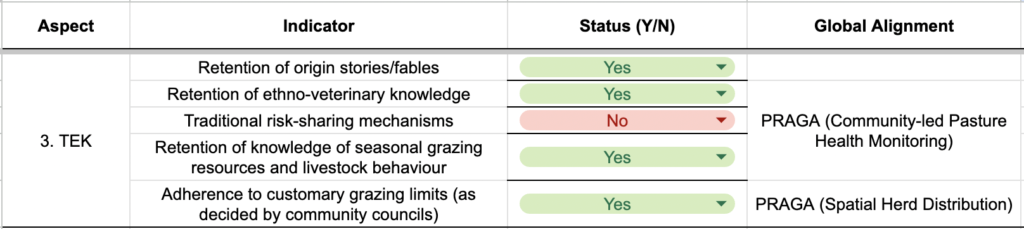
Indicators for Traditional Ecological Knowledge on CETARA-PM: The rating tool will incorporate the rich traditional ecological knowledge of the Gujjar household using the five indicators as given below. This will enable the tool to arrive at a rating that reasonably denotes the sustainability measure of the dairy produced by that particular household’s pastoral practice.
Resilience
An occupation as old as human history couldn’t have survived till today had it not been adaptable and resilient. With mobility and deep ecological knowledge as their strength, they are able to adapt to unpredictable weather, shifting land-use patterns, and socio-political changes. Even as their indigenous Gojri buffaloes are hardy and do not fall sick easily, the Gujjars have communal practices of giving away buffaloes from their herd to another Gujjar household in case they lose their herds to an accident or disease.
In the last two decades, the Gujjars have introduced diverse changes in their pastoralism with the changing times. They have adapted to new, shorter routes due to increasing restrictions in grazing permits. This is also why they have diversified their fodder management with the use of crop residue for feeding, storing dry fodder in case of shortage, and growing their own fodder crops on small patches of land. Another new practice has emerged among the Gujjars: while earlier, they used to sit on pasturelands overnight while migrating to alpine meadows, the Gujjars now take their herds on agricultural lands to graze on crop stubble. This is because of the increasing shift of grasslands to farmlands owned by locals.
Impact on dairy: These mechanisms of resilience among the Gujjar pastoralists makes them reliable producers in the market who adapt well to the changing circumstances around them, while staying rooted in ecology.
Indicators for Resilience on CETARA-PM: The rating tool will incorporate the resilience of the Gujjar household using the three indicators as given below (adapted from the SHARP+ and TAPE global tools). This will enable the tool to arrive at a rating that reasonably denotes the sustainability measure of the dairy produced by that particular household’s pastoral practice.

Tenure Security
The traditional right of the Nomadic Gujjars to live and have traditional seasonal access on forestlands are recognisable under the Scheduled Tribes and Other Traditional Forest Dwellers (Recognition of Forest Rights) Act, 2006, commonly referred to as the Forest Rights Act (FRA). In the past, the rights and contribution of the Nomadic Gujjars were not recognised by the State. However, the State course-corrected this historical injustice to such forest-dwelling communities with this law, recognising their role in the survival and sustainability of the forest ecosystem. This law overrides all other forest laws by recognising the community’s rights to protect, conserve, and regenerate forest resources that they have been traditionally accessing. Additionally, the Himachal Pradesh government has initiated multiple mechanisms, including the formation of Grazing Committees and the much anticipated PEHEL announced in January 2026. This will ensure access to grazing pastures and migration corridors for the pastoralists.
Impact on dairy: Tenure security under the FRA for a Gujjar household directly impacts fodder availability and mobility for the Gojri buffaloes, thus improving their milk productivity and milk quality. Further, with the community right to protect and conserve forest ecosystems traditionally accessed by them and their traditional ecological knowledge of the forests, the Gujjars can maintain the health of these forests and ensure that good-quality seasonal grasses and water are available for the even in the future, ensuring sustained dairy production amidst the testing times of climate change and heat stress.
Indicators for Tenure Security on CETARA-PM: The rating tool will incorporate the tenure security of the Gujjar household using the three indicators as given below (adapted from the WISP – Statutory vs Customary global tool). This will contribute to the rating that gets generated at the end, which reasonably denotes the sustainability measure of the dairy produced by that particular household’s pastoral practice.

Economic Diversity
Nomadic Gujjar have traditionally relied on animal husbandry as their livelihood, with dairy as their primary source of income. With raw milk having a short shelf life of 3-4 hours, Gujjars have learnt to be diverse in their dairying practice. They sell raw milk twice a day to local milkmen when they are in the foothills, where transportation is easy and markets are nearby. For the 3-5 months when they are in high-altitude meadows, tough terrain and distant markets increase the chances of milk spoilage. So they turn raw milk into khoya (and ghee) to ensure a longer shelf life. They then take these to the nearby markets once every 5-8 days.
Other than milk, the Gujjars also used to sell bulls to farmers as draught animals and take their donkeys on hire for transportation. Today, as the Gujjars and other pastoralists compete with large dairy industries and MNCs, in addition to shrinking grazing commons, mobility restrictions, mechanisation of farms, etc., they have diversified into non-pastoral income sources to sustain their livelihood. Some family members from their household take agricultural land on lease to farm (to grow grains and often fodder crops), manual jobs because of their good physical build, or open dairy shops.
Impact on dairy: Income diversification of a Gujjar household ensures economic security during uncertain times or lean seasons. While some members continue dairy production as part of their traditional livelihood and identity, other members support the household through non-pastoral incomes. This also reduces their chances of distress during climate shocks, market instability, or other external circumstances.
Indicators for Economic Diversity on CETARA-PM: Based on the diverse dairy- or non-dairy-based sources of income of a Gujjar household, the rating tool will incorporate the economic resilience/stability of the Gujjar household using the three indicators as given below (adapted from the TAPE – Resource Optimization global tool). This will enable the tool to arrive at a rating that reasonably denotes the sustainability measure of the dairy produced by that particular household’s pastoral practice.

Governance
Nomadic Gujjars have been historically excluded from accessing schemes and equal rights for a long time. Even today, access to education, healthcare, welfare schemes, and veterinary services remain limited among the community due to social marginalisation and lack of land ownership. This hinders their level of awareness to access these schemes as well as their proclivity to organise themselves into cooperatives or producer organisations for better market opportunities. However, the community has its own customary system of self-governance and organisation, called the painchi.
A painchi is a baithak of a wise council of elderly members that is called upon in cases of conflict regarding grazing access, violation of traditional rules in accessing the forest, marriage, or livestock, inter-community relations, etc.
Impact on dairy: Access to social, livelihood, and veterinary schemes increases the resilience of a Gujjar household in times of need. Similarly, a household’s participation in community-led FPOs or cooperatives gives them better agency over the price of their produce, and further increases their collective resilience in times of need, such as micro-finance loans, direct market opportunities, better input cost in bulk, etc. Since customary governance institutions are known to enable the community in maintaining kinship relations within and outside the community, Gujjar households that continue to sustain active painchis are likely to be living in harmony with each other and with their surroundings while adhering to traditional sanctions. All these factors have a direct impact on a Gujjar household’s ability to stay resilient in their dairy livelihood practice.
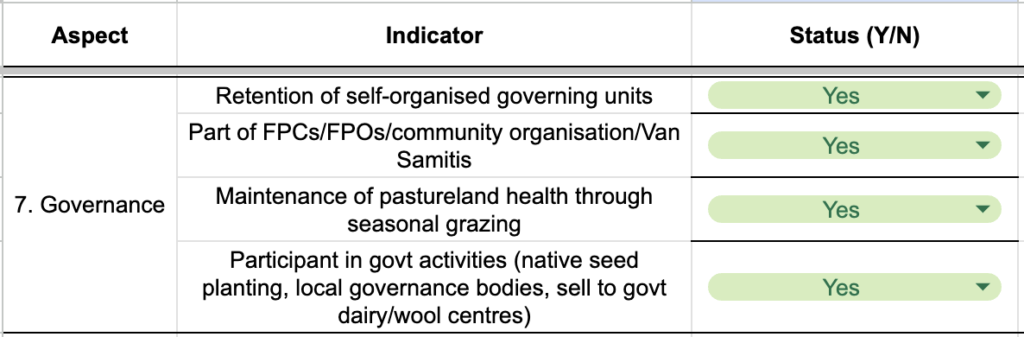
Indicators for Governance on CETARA-PM: The rating tool will incorporate the self-governance aspect of the Gujjar household using the four indicators as given below. This will enable the tool to arrive at a rating that reasonably denotes the sustainability measure of the dairy produced by that particular household’s pastoral practice.
How CETARA-PM Can Get ‘True’ Prices For Pastoral Dairy
Under CETARA-PM, each Gujjar household will get a digital ID or PEHEL ID that can be linked with the PEHEL scheme. The household will then be able to self-assess the sustainability of its practice with yes/no answers. For each aspect, the tool further streamlines indicators that can be adapted according to the local context of a production system.
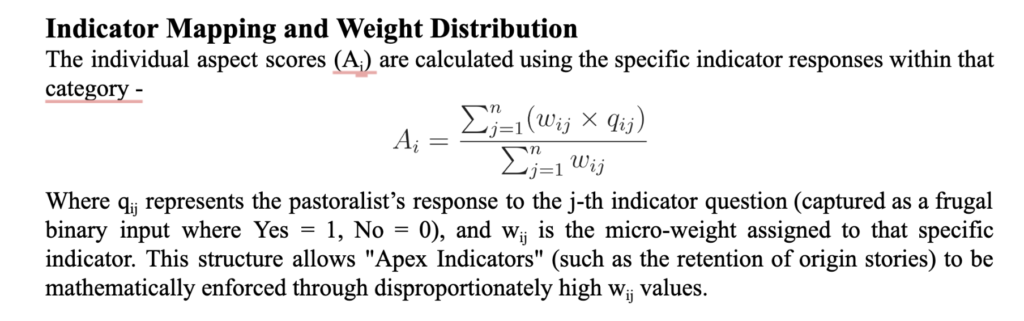
To convert these qualitative observations received from a household’s self-assessment into verifiable data that can be incorporated in government schemes and market chains, the backend of this tool uses a hierarchically weighted index mapped to SHARP+, WISP, PRAGA, and TAPE adapted indicators. This ensures the global efficacy of the CETARA-PM tool via localised metrics. This also allows a tool such as CETARA-PM and a Ledger-based system such as Dharan-da-Lekha to be easily adaptable in other countries with similar pastoral profiles.
Each indicator carries a micro-weight and macro-weight that can be set by a participatory committee of scientists, pastoralists, and practitioners, who are informed by the local context, and carefully examine the sustainability factor of each of these indicators.
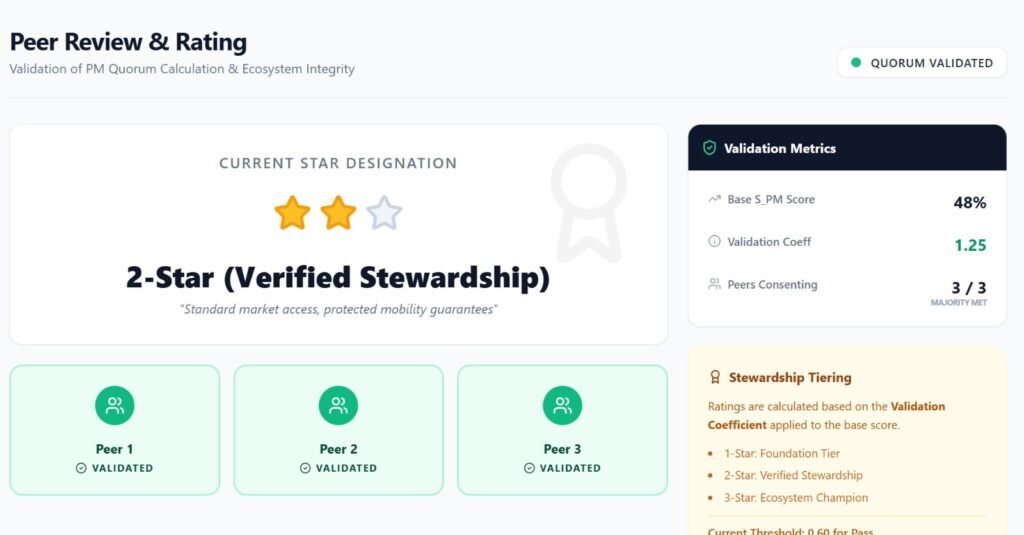
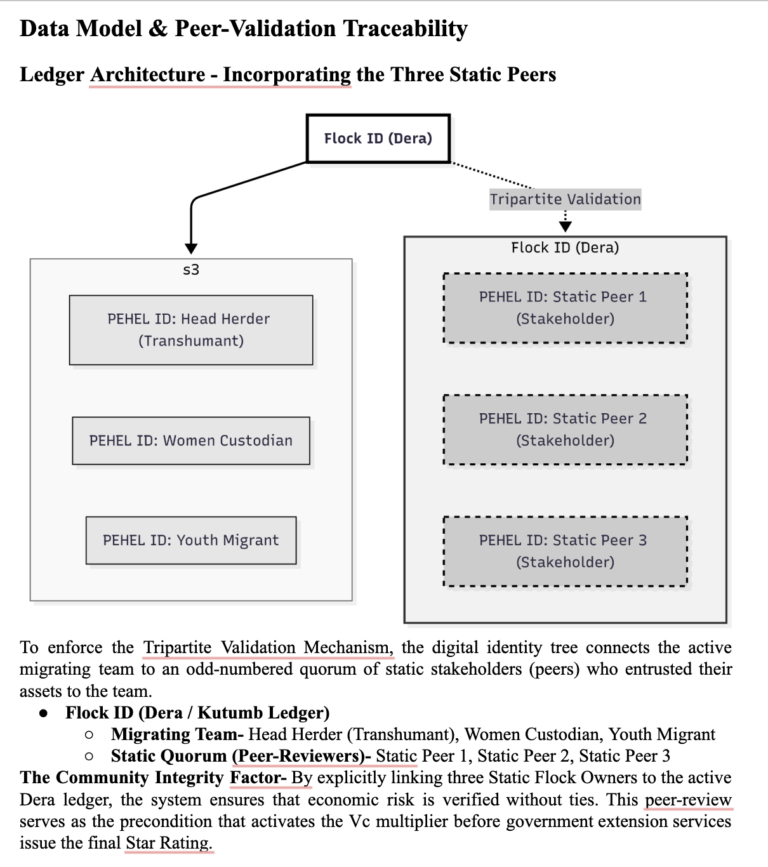
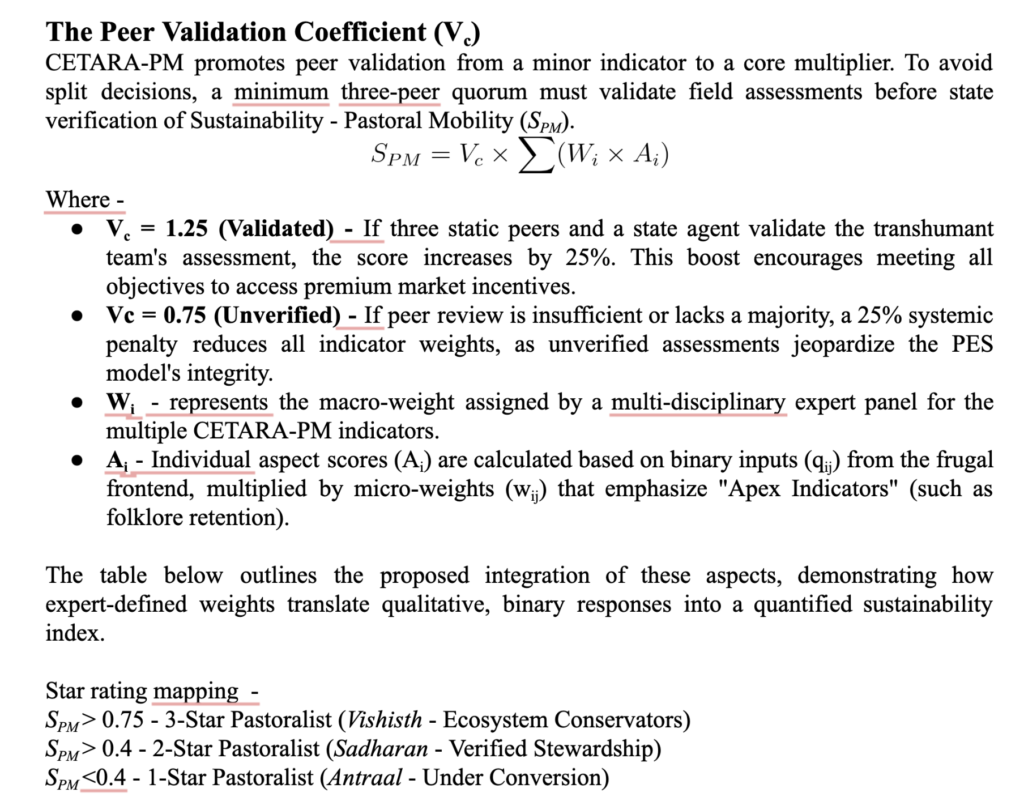
Once the self-assessment is complete, it gets peer-validated by at least three members of their painchi, and the static flock owners who have entrusted their herd for the sojourn, thus acknowledging and incorporating the customary rules of their self-governance system that has played a vital role in maintaining commons resources. The inputs submitted produce a sustainability rating of the household, putting large weightage on peer validation and their ecological stewardship.
The tool uses the following formula to incorporate peer validation into a quantifiable sustainability index.
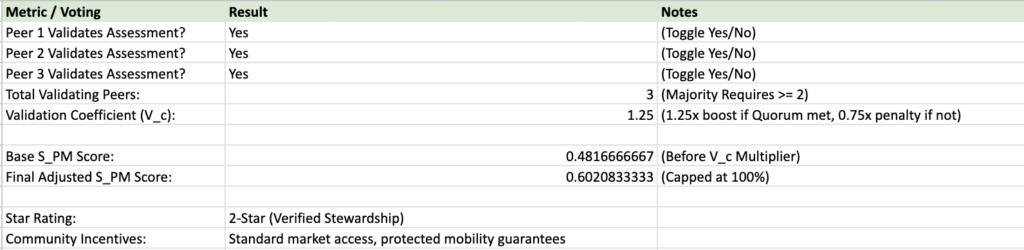
Overall, the CETARA-PM architecture identifies and translates a community’s ecological stewardship and sustainability production practice into a market chain that prioritises true pricing for the pastoralist-producer who produces dairy, and traceability and transparency for the consumer who picks up a packaged bottle of this dairy product.
Next Steps
The CETARA-PM tool has been conceptualised and tested in the field with Gujjar pastoral households to arrive at indicators relevant to a pastoral practice. Parallelly, we have been working on building a value chain in which such a tool can be realised. This requires:
a) an organised group of pastoral-producers who believe in continuing pastoralism as a sustainable practice and consent to transparency in their production,
b) pastoral products with credible quality that can get true price to the producer,
c) customer-friendly brand that promises the traceability of each product, and
d) suitable analytics to measure sustainability factors and indicators which are close to the hyperlocal lived reality of the pastoral communities.
Over the last one year, we have been working on all three aspects, including a nutritional analysis of a sample ghee sourced from a Gujjar pastoral household in Sirmaur district, Himachal Pradesh.
Why ghee: In a Gujjar pastoral household, ghee is prepared using traditional methods by Gujjar women for domestic use throughout the year. Interestingly, it is believed by the community that the quality of the ghee prepared in the meadows is more aromatic, thicker, and more nutritious because of the rich grasses consumed by the buffaloes during summers. This is the time when a Gujjar household usually migrates with their buffaloes to high-altitude alpine meadows. Additionally, ghee is a promising dairy product for the case study because of its long shelf life, easier transportability, and wide application in the kitchens across many parts of the subcontinent.
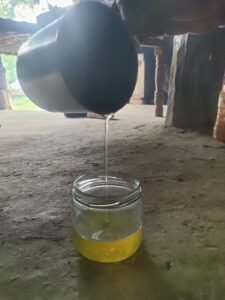
The nutritional analysis of a Gujjar household’s ghee will bring credibility to the community’s knowledge and claim. Along with the analysis, we’ll also be undertaking a True Price Discovery using the MoolyaSHIKHAR methodology to identify the price of a ghee product that can bring true price to its pastoral-producer.
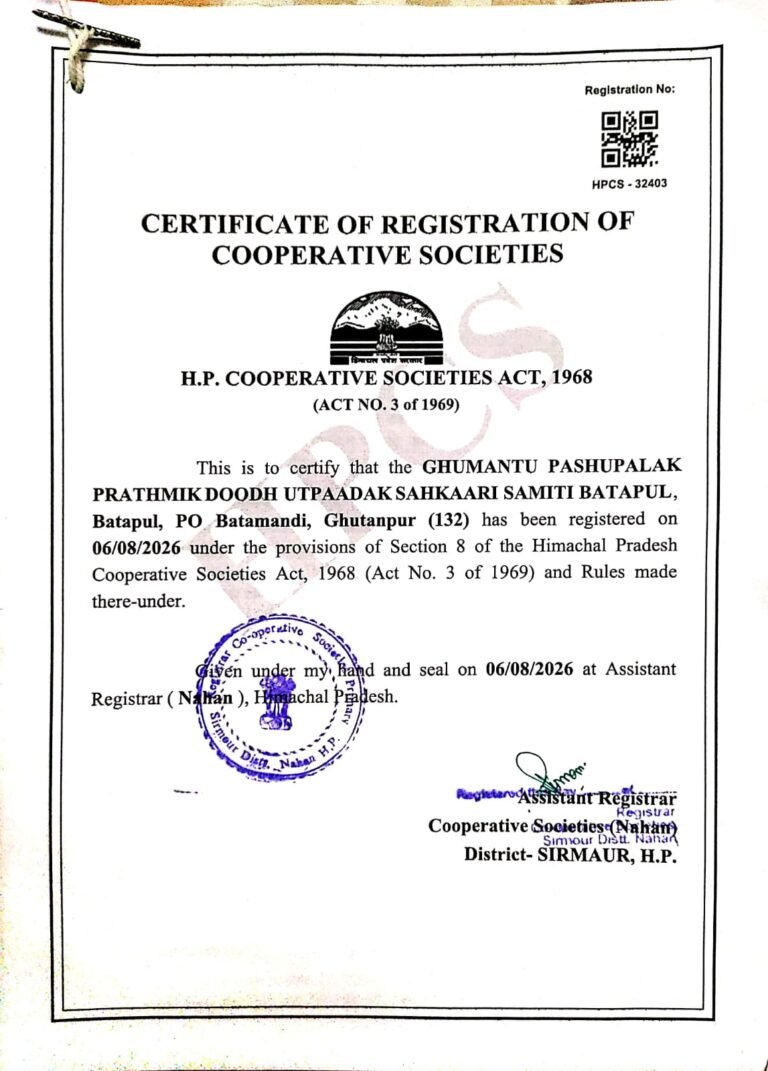
The ghee sample being sent for testing has been sourced from a Gujjar household, while it has been in its traditional summer pasture of Churdhaar (Sirmaur) since March-end. By September-end, the household will reach its winter pasture near Paunta Sahib. The household is also a part of the dairy cooperative ‘Ghumantu Pashupalak Prathmik Doodh Utpaadak Sahkaari Samiti Batapul’. The cooperative was registered on August 6, 2026, in Paunta Sahib block (Sirmaur district).
While this intervention appears simpler in logic, the experience of getting a sample of ghee from the remote meadows of Churdhaar to an NABL-accredited lab in the heart of Delhi has not been a smooth ride. We’ll be getting into the process behind these interventions and outcomes in the next article.